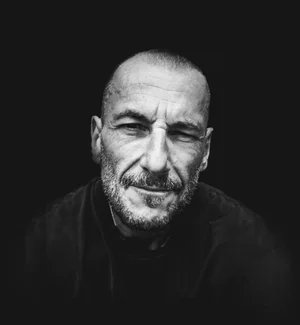
Don’t fight it, feel it.
There's a man I know — good man, by most measures — who hasn't cried in eleven years. He told me this like it was something to be proud of. Like endurance. Like the absence of feeling was proof of strength rather than evidence of a slow, quiet emergency happening somewhere underneath the floorboards of his life.
I didn't say anything. I recognised him too well.
Because I spent years in the same quiet wreckage. Drinking heavily. Working hard. Numbing everything that got too close to the surface. I was with a woman I wasn't right for and she wasn't right for me, and both of us knew it, and neither of us said it out loud for years. Because I loved my kids so completely that I couldn't picture a life where I wasn't in it every single day. Couldn't picture the Tuesday mornings, the school runs, the ordinary nothing moments that turn out to be everything. So I stayed. Shrank myself down to fit a life that didn't fit. Told myself it was sacrifice. Told myself it was for them.
It wasn't. Not really. It was fear dressed up as devotion. The most quietly selfish thing I ever did — choosing half a life just to avoid the terror of building a better one. Staying small so I didn't have to risk becoming bigger. Present in body. Absent everywhere else. Showing up every day and calling it enough, when the truth was I was just too frightened to find out what I was actually capable of.
That was part one. The version of me that was entirely out of line with himself.
For most of that time I operated on a simple principle: identify the problem, fix the problem. Emotions were just inefficiencies in the system. Discomfort was a signal to push harder, drink another glass, take on another project, outrun whatever was gaining on me. I was very busy. I was also, in ways I couldn't yet name, completely unavailable — to the people around me, and to myself.
The tools helped. I won't pretend they didn't. The structure, the routines, the discipline of building a body and a schedule worth showing up for — that was real. Those things gave me a foothold when I had nothing else. But they were the scaffold, not the building. You can optimise your morning and still feel hollow by noon. You can run a hundred miles and still be running from something. The habits create the conditions. They do not do the deeper work.
Because the deeper work isn't about what you do before 6am. It's about what you're willing to look at when the doing stops.
The body keeps score. This isn't a metaphor — it's biology. Trauma, stress, chronic suppression, the years of swallowing things down because you didn't have time or permission or language for them — all of it lands somewhere physical. In the shoulders, the jaw, the chest, the gut. In the way you flinch when someone asks how you really are. In the way you reach for your phone the second a quiet moment opens up, because quiet has started to feel like an ambush.
I've run hundreds of hours on my own — sometimes on mountains, in high exposed places where there's nothing to do but move and think and eventually stop thinking and just be in the body. And I've noticed that somewhere around hour three or four, when the performance drops away and the ego gets too tired to keep its hand up, something else surfaces. Feeling. Real feeling. Not the managed, curated version I present to the world. The actual stuff. Grief sometimes. Joy sometimes. A love for my children so acute it almost hurts to hold. Fear. Gratitude so large it doesn't fit inside normal life.
There have been moments — ridge lines in the Peaks, a long descent into nothing but cloud and silence — where something cracked open and I just let it. Stood there on my own, breathing hard, crying without entirely knowing why, and feeling more like myself than I had in months. The mountain doesn't care about your narrative. It just puts you under enough pressure that eventually the real thing comes up.
"Sometimes it takes you a long time to sound like yourself." Miles Davis
Understanding yourself is a fundamentally different project from fixing yourself. Fixing assumes you're broken. Understanding assumes you're human. And humans aren't broken — they're adaptive. Every behaviour you've developed that now looks like a problem was once a solution. The numbness, the drinking, the staying, the distance — these weren't failures of character. They were strategies. The best ones you had at the time. The question isn't what's wrong with me, it's what did I need, and how did I learn to get it.
That's a softer question, but it isn't a soft question. It requires a kind of unflinching honesty that most of us spend enormous amounts of energy avoiding. Because understanding yourself means sitting with what you find. The parts that are scared. The parts that are angry. The parts that are still, at forty-something, waiting for permission to be loved as they are rather than as they perform.
We build lives, all of us, that are very good at keeping the real questions at a safe distance. Stay busy enough and the question never gets a chance to form. Stay numb enough and even if it does, you won't hear it. The specific armour differs — overwork, perfectionism, people-pleasing, drinking, scrolling, the relentless performance of having it together — but the function is the same. Don't feel it. Don't deal with it. Keep moving.
And we pay a quiet, accumulating price for that. All of us.
Next time something stings — a comment, a rejection, a moment of loneliness in a room full of people — instead of immediately moving to fix or distract or explain, just pause. Ask: what is this actually about? Not what should I do about it. Just: what is this.
Sit with the answer. Even if it's uncomfortable. Especially if it's uncomfortable. Because the feeling knows something. The feeling is trying to tell you something. And if you can tolerate it long enough — give it your attention, let it move through rather than shutting it down — you'll find it eventually passes. And when it passes, it leaves something behind. Not wreckage. Understanding.
That's how you change. Not through willpower or an earlier alarm or another book about discipline. You change by becoming more honest with yourself about what's actually happening inside you. You change by developing the capacity to feel without immediately fleeing. That's the work. Uncomfortable, unglamorous, invisible to everyone else. The kind of work that never makes it onto anyone's highlight reel.
But it's the only work that actually changes anything that matters.
The person who hasn't cried in eleven years isn't strong. They're defended. And there's a difference — one worth sitting with.
You probably already know which one you are.
The question is whether you're ready to start listening.
Big love
Chris